Practical Life
Exercises of Practical Life are ordinary simple tasks to help a child learn how to care for oneself, the environment, and others. Adults have been conditioned to focus on the product or result. Yet, young children of the first plane live in the present and are fulfilled by the process rather than the product.
Benefits of Exercises of Practical Life- Develops functional independence
- Improves coordination of movement
- Develops the will
- And builds concentration
- Adaptation and Orientation: It helps the child pursue a social life where they come to participate and lead
Areas of Practical Life- Preliminary Exercises
- Care of Self
- Care of Environment
- Grace and Courtesy
- Control of movement
- Characteristics of the Materials:
- Child size
- Psychologically appropriate
- Well maintained
- Attractive
- Complete
- Similar but can tell the difference by color coding
- Culturally specific
- Organized simple to complex
- Full cycle of activity
- Serves as a direct preparation for the next work
Sensorial
The training of the senses is the matter of the greatest importance in education.
- There is no way to understand the world unless we can detect it from our senses.
- It is the brain’s real source of food.
“If the food is rich, that is the food it has. If it is scarce, then that is the only form of nourishment it has.”
It is stronger and weaker depending on what is available in the environment.
Sensorial Exercises help neuro-connections in the brain become stronger. It helps the child become conscious of the physical property of the world such as taste, smell, texture, color.
Aim:
- Classify and organize their sensory perceptions
- Refine his powers of discrimination
- Build intellect
- Develop Abstraction
- Assist in the powers of accurate memory
- Develop operational understanding of the world
- Creation of life long skills (order, exactness, and precision)
- Develops aesthetic sense and artistic creativity (prepares for the mathematical mind)
Sensitive period for sensorial refinement only happens from birth to 6 years. Once the child has had lot of opportunities to explore EPL & Sensorial, only then can we give them the name and language associated with it.
Language
Spoken Language:
- Give language so children can be confident in expressing themselves.
- The freedom to explore allows them to gain ideas which expand their intellect.
- Adults act as role models and children absorb everything so we must use precise language.
- Activities: cultural folders, book reading, reading poems, storytelling
Written Language:
- By identifying the symbol and sound, the child may discover the ability to read and write (explosion into writing).
- We teach writing before reading because reading is more complex
- Meanwhile, preparation of the hand for mechanical writing is important.
- The child will explode into writing leading into total reading once they are able to recognize symbols and sounds.
- Activities: phonetic reading, then phonograms and puzzle words, reading classification, function of words activities, reading analysis, and word study.
Total Reading:
Is when the child understands what he/she reads, and also appreciates:
- the style of writing
- the author’s feelings and emotions
- and the entire message the authors is trying to convey.
Math
EPL, Sensorial, and Language activities are indirect preparation for structure and patterns of Math.
2 challenges we see in this age group:
- Children may not understand quantity as a concept yet. For this reason, children probably won’t understand what number means or that it represents a grouping of individual units to form a whole.
- Working with large numbers can be hard because children concretely only have 10 fingers to count with. The bead cabinet was developed to help the child work with large quantities in a physically and psychologically understandable manner.
Four tendencies that guide the mathematical mind:
- Order
- Exactness
- Abstraction
- calculation
Math Materials:
- Numbers 1-10: number rods, spindle boxes, cards and counters
- Decimal System: golden beads, stamp game, dot game, word problems
- Counting: teen boards, ten boards, long chain and short chains, and bead cabinet
- Memorizing the four operations
- Passage to Abstraction
- Fractions
We cannot teach the child the concept of abstraction but allow them the experiences and opportunities to understand and perceive it through their own natural process
Movement
All children are working to refine their movement.
Examples:
- pouring water activity helps child work on coordination of movement in their hands to avoid over pouring, under pouring, and master exactness.
- Walking on the line is difficult to do at first but through repetition, the child may even be able to balance objects on their head while walking on the line.
Normalization
“Normalization, it is the most important single result of our whole work.” -Maria Montessori
Characteristics:
- Love Work
- Deep Concentration
- Obedient
- Independent
- Ability to judge and reason
- Connected to reality
- Learns to be delicate
- Desire to know, love, and serve
- Love silence
- Inner discipline
- Spiritual strive towards perfection
- Finds Joy
Human need and Tendencies
- Natural urge/impulse which lead without conscious design to certain actions to satisfy the human’s physical and spiritual needs.
- Allow the child to understand the concept of how to do things for themselves.
- The physical needs for food, clothing, shelter, defense, and transportation must satisfactorily be met to thrive and survive.
- The spiritual needs for love, compassion, religion, and community must be met to thrive and survive.
Exploration, Orientation, Order, Communication, To know/To Reason, Abstraction, Imagination, Mathematical Mind, Work, Repetition, Exactness, Activity, Manipulation, & Self-Perfection.
Independence
Help the child help themselves. As the child is given opportunities to exercise independence, they gain awareness of what they can do for themselves, how their decisions affect others, and what they can now for themselves, they can also do for others.
Infants explore and orient themselves to their environment.
Toddlers can begin purposeful work. A child who feels capable and self confident in the world develops independence.
Children’s House has the freedom choose, move, repeat. They become normalized, demonstrating love of work, concentration, self discipline, sociability, and a developed will.
Social Development
Education as a means for social change…
The child’s contribution to the world is through social development and social cohesion.
Social Development starts at birth in the home. In the children’s house, we provide individual presentations so that they can work on constructing themselves. Small group work is introduced later around age 5-6 because they have a need to associate themselves with others. The quality of social cohesion depends on prepared adult and prepared environment.
It is the society of little children who are guided by the magical powers of nature. We must value and treasure it, because neither the character nor the social sentiment can be given by teachers. They are the products of life.” (Montessori, The Absorbent Mind pg 234)
Freedom and Discipline
Misconception: Discipline is a form of punishment and rewards
- Discipline is cultivated within the child and developed by the child when he/she freely and actively perfects themselves.
- Discipline is an act of creation not an act of restriction.
Necessary Conditions to Grant Freedom
- Provide mental and physical work suited to attributes and capabilities.
- Be rooted in Knowledge.
- All members of the community needs to be involved.
- Consistency in providing order.
- Have a control of error.
- Independence granted in a way that is constructive.
- Choice/Repetition, if the child chooses, they will strengthen their freedom/will.
- Basic Guidelines: care for self, others, and environment.
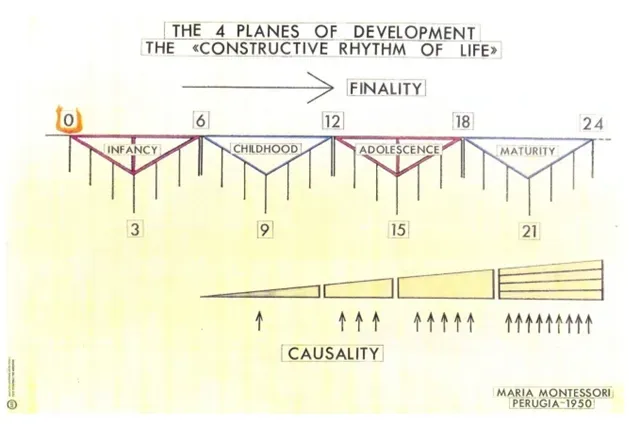
The Four Plans of Development
The first 3 years is to construct. The next 3 years is to refine.
Maturity period from ages 18-24 finalizes development and norming of the human species: finality
Causality is based on the concept that the more teachers and subjects taught in a traditional school setting is a result of who the child will become.
.